Today the most common signals sent between drones and their controller units are digital commands encoded on an analog carrier wave.
In the past analog controllers had a noteworthy advantage for their relatively low latency. But improvements in digital signal processing have relegated the old analog control systems of yesteryear to the wayside.
Controlling your drone over the airwaves with radio signals that are converted into digital commands brings these advantages over analog commands:
- More types of sophisticated data can be sent with digital, like GPS, navigation controls, and telemetry
- Digital signals allow for higher precision such as multiple simultaneous navigation inputs
- Digital commands can include error correction that reduces noise and interference
- With the market shift to digital, digital components are relatively easy to come by, and therefore also cheaper
This page will cover these topics:
- What is a Carrier Wave?
- Keying and Shift-Keying
- FSK – Frequency Shift Keying
- PSK – Phase Shift Keying
- BPSK, 2PSK – Binary Phase Shift Keying, a.k.a. 2PSK
- ASK – Amplitude Shift Keying
- GFSK – Gaussian Frequency Shift Keying
- QAM – Quadrature Amplitude Modulation
- QPSK – Quadrature Phase Key Shifting
- OQPSK, SQPSK – Offset Quadrature Phase Key Shifting (Offset QPSK), a.k.a. Staggered QPSK
- MSK – Minimum Shift Keying
- GMSK – Gaussian Minimum Shift Keying
- OFDM – Orthogonal Frequency Division Multiplexing
- Multi-Channel Manipulation Techniques
- FHSS – Channel Frequency Hopping
- DSSS – Direct-Sequence Spread Spectrum
- Modulation for Video Streams
- Controlling Drones on a Cell Network or Wifi Network
- Drone Telemetry Transmission Techniques
- LoRa
- GMSK
- MAVLink
What is a Carrier Wave?
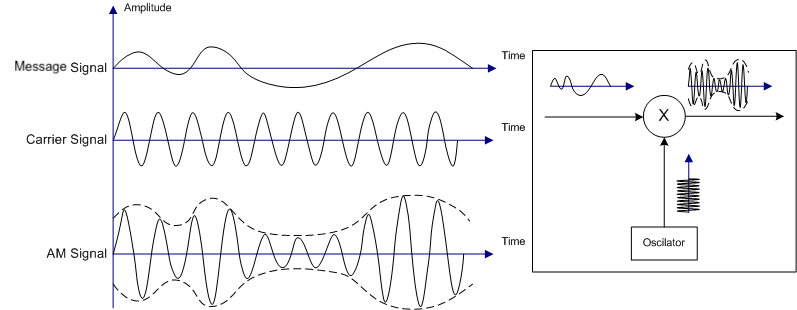
A carrier wave is a radio wave. It has properties of amplitude, frequency, and phase. You can modify any one or combination of these to encoded digital data. Basically imagine a sine or cosine wave from your geometry class.
Keying and Shift-Keying
The term “keying” has its origins in the days of Morse code, when long and short beeps were used to code for letters and numbers at the advent of radio in the 19th century. Pressing a key played the tone that was transmitted over the radio.
Nowadays “shift-keying” involves altering the properties of a carrier wave to encode a signal that can be read digitally; the 36 beep-coded alpha-numeric system of Morse code has been reduced to binary ones and zeros.
- FSK – Frequency Shift Keying: This type of shift-keying modifies a carrier wave’s frequency to encode a digital signal.
- PSK – Phase Shift Keying: This method of shift-keying modifies a carrier wave’s phase to encode a digital signal. In other words it shifts the sine’s or cosine’s wave position on the x-axis.
- BPSK, 2PSK – Binary Phase Shift Keying, a.k.a. 2PSK: This is a specific type of PSK where binary data (bits) are encoded by shifting the carrier wave exactly 180 degrees on the X axis of a graph. A zero might be the wave at 0 degrees, and a 1 might be the wave at 180 degrees.
- ASK – Amplitude Shift Keying: This shift-keying method works by modifying a carrier wave’s amplitude to encode a digital signal.
- GFSK – Gaussian Frequency Shift Keying: This runs FSK through a Gaussian filter. FSK works by modifying frequency, so modified frequency that’s run through a bell-curve filter helps to smooth out its frequency shifts, more clearly separate different channels, and improve signal integrity. Think of GFSK as FSK that just had a nice cup of coffee.
- QAM – Quadrature Amplitude Modulation: This type of shift keying transmits two carrier waves, so ultimately codes for two pieces (bits) of digital data. It’s a combination of ASK and PSK. The two carrier waves are out of phase with each other by 90 degrees (this makes them quadrature, a term from geometry). Furthermore the amplitude of each carrier wave is modified to convey a digital signal (ASK). This doubled data rate transmission is more common for drones that are transmitting larger amounts of data, such as FPV drones with a video feed.
- QPSK – Quadrature Phase Key Shifting: QPSK Shifting involves sampling data at four points on an XY graph. The data is sampled from two sine or cosine waves that are 90 degrees apart (making them quadrature). This allows for the transmission of two points (bits) of digital data.
- OQPSK, SQPSK – Offset Quadrature Phase Key Shifting (Offset QPSK), a.k.a. Staggered QPSK: This type of data transmission takes a QPSK signal and offsets its sampling by half a period, focusing this offset on the transition period that signals when a new bit is encoded (these transitions can be very stark). Doing this smooths out (staggers) abrupt changes in the digital signal which leads to better signal reading with less errors.
- MSK – Minimum Shift Keying: This method of transmission involves keeping the carrier wave’s amplitude unchanged, while gradually and continuously shifting phase so as to make phase transitions smooth and not abrupt. Because the phase is continuously shifting, you could also describe this as gradual and smooth frequency modulation.
- GMSK – Gaussian Minimum Shift Keying: This takes an MSK signal and runs it through a Gaussian filter, making the already-smooth signal transitions of MSK even smoother. This improves the signal’s efficiency even further.
- OFDM – Orthogonal Frequency Division Multiplexing: This is a clever method for transmitting relatively larger amounts of data. It uses a relatively wide bandwidth which centers around one carrier wave. Sub-carrier waves at varying frequencies are included in the transmission. These sub-carrier waves are encoded with data using shift keying techniques. Data is encoded on the sub-carrier waves so that these remain orthogonal to each other. In other words, that means the sub-carrier waves won’t interfere with each other; they are spaced in such a way so that one wave’s peak will occur at another wave’s trough.
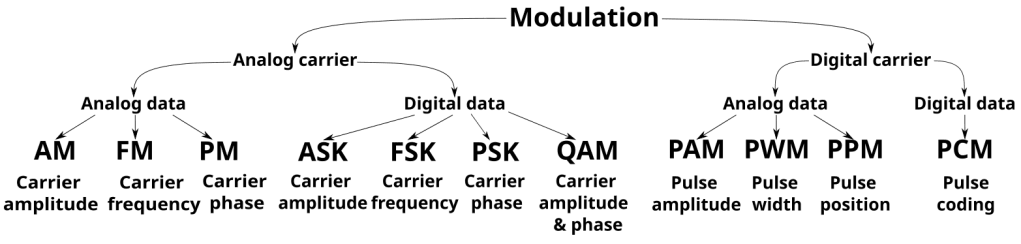
Here’s an illustrative diagram on where all these shift-keying techniques fall within the broader topic of radio communication:
Multi-Channel Manipulation Techniques – FHSS and DSSS
Apart from shift keying modulation techniques that alter a carrier wave’s amplitude, frequency, and/or phase, FHSS and DSSS techniques take advantage of multiple channels to aid in the transmission of data.
Channel Frequency Hopping (FHSS)
This is also simply known as channel hopping. To conceptualize this, take the example of a drone RC unit operating between 2.408 GHz and 2.475 GHz. That’s a range of 67 MHz (0.067 GHz). The channel bandwidth size at this frequency is typically 0.5 MHz. So, this means that within this range there are 134 channels.
This is like having 134 different stations on your FM radio to listen to and receive information from. Now let’s say you want to transmit a sentence over your FM radio cleverly. You could arrange to say your sentence one word at a time, and that each word would be broadcast on a different station. So to say, “I love to fly drones”, you would say “I” on channel 1, “love” on channel 15, “to” on channel 101, “fly” on channel 77, and “drones” on channel 22 (in this case the channels you use are assigned randomly in a random order).
This is what channel hopping is, done between your handheld drone RC unit and your drone, up to 100 times per second. Channel hopping can have several advantages:
- Minimized interference
- Better security
- More difficult to jam
- Ability to avoid channels that are already in use by other devices, or channels that are less ideal because of environmental factors
You may see features like FHSS advertised with drone remote controls as “AFHDS” which stands for Automatic Frequency Hopping Digital System. This is proprietary, developed by FlySky. Their AFHDS2A is advertised as AFHDS with additional error correction built in for better signal reading.
Fact is, most consumer drone RC units will include some form of FHSS. Some are developed by these better-known companies:
- FlySky
- Spektrum DSMX
- Futuba FASSTest
- O3+
- ExpressLRS (ELRS)
Adaptive Frequency Hopping – You may also see this term. This is FHSS, but the software is capable of determining which channel frequencies are best for the environment your drone is operating in (considering things like radio interference and physical obstacles), and these ideal channels are subsequently used.
Direct-Sequence Spread Spectrum (DSSS)
In a basic data transmission setup, one binary bit of data is encoded on a carrier wave signal that’s sent over the airwaves on a specific frequency within a designated bandwidth (channel). With DSSS, instead of sending that one bit of data on one channel, that piece of data is copied and sent on multiple channels; a “spread spectrum” of channels. When being read by the receiver, the receiver condenses the spread back down into a coherent signal. This technique has several advantages:
- Improves the receipt of the signal through the use of redundant channels and bits of data
- Improves resistance to interference
- Improves security
This technique can also be combined with FHSS.
Modulation for Video Streams
If your drone is transmitting video back to you, it’s likely to use transmission methods that can accommodate relatively high amounts of data. These are some of the most common ones:
- QAM
- Analog FM at 5.8 GHz (higher frequencies = higher rates of data transmission)
- DSSS and FHSS
- OFDM
Controlling Drones on a Cell Network or Wifi Network
It’s becoming increasingly common to operate drones over cell networks. Wifi networks are commonly used too. Both of these methods rely significantly on these data transmission techniques we’ve already covered:
- QAM
- PSK
- OFDM
Drone Telemetry Transmission Techniques
In addition to a video feed, drones also often transmit telemetry data. This has unique properties:
- Sending GPS location coordinates, battery voltage, heading, speed, and other alpha-numeric data requires relatively simple methods of data transmission, compared with an HD video feed
- It’s preferable to favor characteristics like good signal penetration and propagation when sending this relatively simple data; maximizing large amounts of data transmission favors signal characteristics that minimize signal penetration and propagation
Because of these characteristics, drone communication units will sometimes have transmission systems designed specifically for sending telemetry data. These include:
- LoRa: An abbreviation of “Long Range”, this is a proprietary technique that uses a Chirp Spread Spectrum (CSS). Sent on frequencies below 1 GHz, the CSS signal uses its entire bandwidth to send a “chirp” signal that’s encoded by frequency modulation. Wide bandwidth, relatively lower frequency, and relatively low amounts of data make LoRa a good option for uniquely sending telemetry data.
- GMSK: The Gaussian Minimum Shift Keying technique addressed above is particularly efficient, uses relatively low amounts of power, is adverse to noise, and naturally blocks other interference. All these properties make it ideal for a telemetry communication protocol.
- MAVLink: An acronym for “Micro Air Vehicle Link”, MAVlink is an open-source communication protocol. It can be installed as part of a drone’s communication system, and provides means for communicating basic telemetry data over user-selected methods that can include FSK, GMSK, and other shift keying techniques, as well as over wifi, cell, and LoRa options.
There are some other options for receiving drone telemetry:
- Stick an Apple AirTag onto your drone and make sure your drone is flying somewhere within cell tower range. You’re not going to impress any drone geeks with this but at the end of the day it gets the job done. Synonyms for AirTags include Tile Mate, Samsung Galaxy SmartTag, Chipolo One, Tile Pro, and Nut Find 3.
- Zigbee can track telemetry data but typically it requires being plugged in to the wall (mains power).
 DIY Drone Guy