This article will focus specifically on the radio frequencies used by drone remote control units. That is, the electronic signals you send your drone over the radio waves with a remote-control device, and the signals your drone sends back to you over the radio waves (if any) regarding details about its telemetry, GPS location, battery voltage, video feed, and so on.
This page covers these topics:
- Frequencies of Radio Signals You Send to Your Drone to Control it
- Benefits and Drawbacks of Different Frequencies
- Channel Bandwidth Size
Frequencies of Radio Signals You Send to Your Drone to Control it
Unless you’re debugging a drone that’s connected to cumbersome dangling TX and RX wires, or you’re flying a drone in a war zone via a thin fiber-optic thread, you’re going to be sending control signals to your drone over the airwaves.
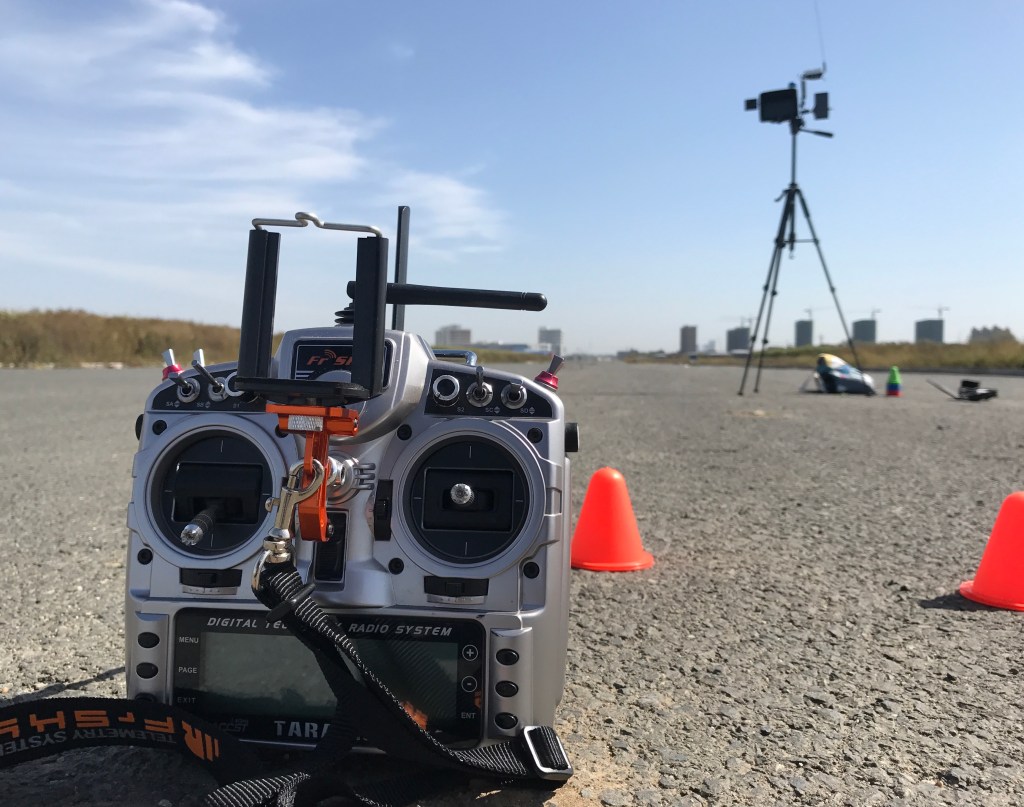
Most likely these will be digital signals, though some models and circumstances may call for analog signals. Either way, the signal is going to be sent over a carrier wave on a specific radio frequency.
So what are these radio frequencies?
- 2.4 GHz, the most common
- 5.8 GHz is increasingly common, especially for transmission of video links
- 900 MHz is well known for its long-range reach
- 433 MHz is also known for its longer range
- 1.2 GHz is also used for both its control communication and video links
These frequencies range from 433 MHz on the low end to 5.8 GHz on the high end. If you don’t want to mix your unit prefixes then either of the following also correctly expresses this range:
- 433 MHz to 5,800 MHz
- 0.433 GHz to 5.8 GHz
Remember your metric prefixes so you don’t get confused:
| Unit | Prefix | Power | Numeric |
| 1 Hz | Hertz (Hz) | 100 | 1 Hz |
| 1 kHz | Kilo Hertz (kHz) | 103 | 1,000 Hz (1 kHz) |
| 1 MHz | Mega Hertz (MHz) | 106 | 1,000,000 Hz (1 MHz) |
| 1 GHz | Giga Hertz (GHz) | 109 | 1,000,000,000 Hz (1 GHz) |
Benefits and Drawbacks of Different Frequencies
If you want to make comparisons to cell network coverage, 900 MHz, 1.2 GHz, and 2.4 GHz fall within the range of 4G (fourth generation cell) and 4G LTE (long-term evolution) networks. 5.8 GHz is within the bounds of 5G (fifth general cell) networks.
As you have likely experienced, with 4G, 4G LTE, and 5G networks there’s a tradeoff between communicating relatively smaller amounts of data over a longer distance, and communicating relatively larger amounts of data over a shorter distance.
Lower frequency communication generally has a longer range and a greater penetration capability through objects like walls and buildings. However it has relatively lower rates of data transmission, which is particularly detrimental to the transmission of video links.
Conversely, higher frequency transmissions can send exponentially higher amounts of data over the airwaves, however these frequencies are easily blocked by obstacles like walls and buildings.
Here’s an example of typical data transmission rates:
- 4G networks can manage the upload transmission of 50 MB per second, and can transmit through walls relatively well
- 5G networks can manage the upload transmission of 1,000 MB (1 GB) per second, but transmit through walls relatively poorly
This is why 2.4 GHz is a standard for drone RC signals. This is a compromise that’s generally acceptable for many consumer drones, allowing a relatively decent drone operating range and adequate data transmission, especially video links transmitted from the drones.
Also, once you go below the GHz range the size of the antennas you’ll need to communicate with your drone quickly begin to grow.
To pragmatically take advantage of the different data transmission frequencies, some drone RC controls send flight commands (relatively lower amounts of data) over a lower frequency, and receive video feeds (relatively higher amounts of data) on frequencies in the GHz range.
An important note: all the radio frequencies mentioned here are line-of-sight. An exception would be if you’re sending your signal over a cellular network (i.e., controlling your drone with a device that has a sim card), in which case your range is limited to the range of your cell network (cell towers); this setup isn’t so common with consumer drones.
Channel Bandwidth Size
While wireless communications between drones and RC control units take place around the frequencies already discussed, signals are not typically transmitted at exactly, say, 2.4 GHz.
Instead they can vary over a range of the radio spectrum. For a 2.4 GHz RC controller a typical range might actually be from 2.408 GHz to 2.475 GHz, thus a range of 0.067 GHz (or 67 MHz).
To conceptualize this range think of your FM radio dial: it starts at 87 MHz and goes to 108 MHz, a range of 21 MHz. And the different channels on your radio? They are stations like 92.9 MHz, or 101.1 MHz. You’ll notice the radio stations on your dial tend to be at least half a MHz apart; that way they don’t overlap and interfere with each other.
For example, compare a station at 99.5 MHz, 100.5 MHz, and 101.5 MHz. Each of these stations is separated by 1 MHz. Another way of saying this is their channel’s bandwidth is 1 MHz. This can be visualized like this:
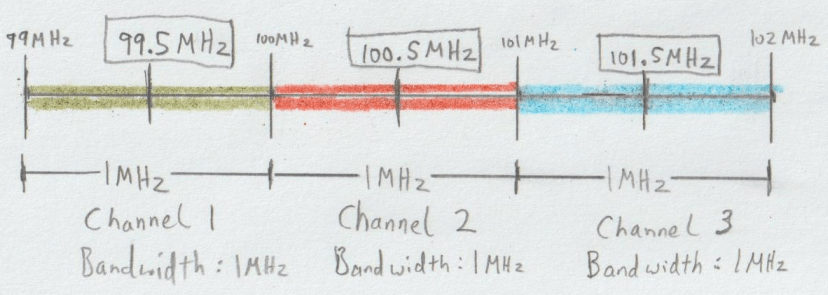
It’s the same with drone RC controls. Whereas a typical range might be between 2.408 GHz and 2.475 GHz, for drones at this frequency a typical size (bandwidth) of a channel is 0.5 MHz (500 kHz).
As you get to lower frequencies channel bandwidth decreases. That’s why drone RC units operating at relatively lower radio frequencies have better penetrating power through walls and buildings. A typical channel bandwidth for a drone operating at 433 MHz is 0.1 MHz (100 kHz).
As you get to higher frequencies channel bandwidth increases. Radio signals with wider bandwidth can transmit more data because they can be modulated more complexly. A typical channel bandwidth for a drone operating at 5.8 GHz is 1 MHz (1,000 kHz).
 DIY Drone Guy