You’ll often see Battery Elimination Circuits (BECs) included with Electronic Speed Controllers (ESCs), flight computers, or Power Distribution Boards (PDBs).
A BEC is exactly what it sounds like. Say you want to attach a 5 volt LED strobe to your drone. You might be inclined to zip-tie the light onto the top and then connect it up to three AAA batteries you tie on somewhere.
Having a BEC eliminates the need for additional batteries. So instead of plugging in your strobe light to the three AAA batteries, you’d save space and weight and simply plug it into the BEC.
A BEC is a branch from existing electronics on your drone that provides a positive and negative terminal for you to plug in accessories to. BECs should typically specify:
- Their output voltage (often 3.3 volts, 5 volts, 9 volts, or 12 volts)
- The types of battery voltages they’re compatible with (1S, 2S, 3S, 4S, etc)
- Max amperage rating
For a simple illustration, imagine you have a 3S battery (11.1 volts) and you want to power a 5 volt accessory, like a 5-volt GPS unit. You can’t plug the GPS unit directly into your 11.1-volt 3S battery, so you connect a 5-volt BEC to your 3S battery, and now you can plug your GPS unit into that.
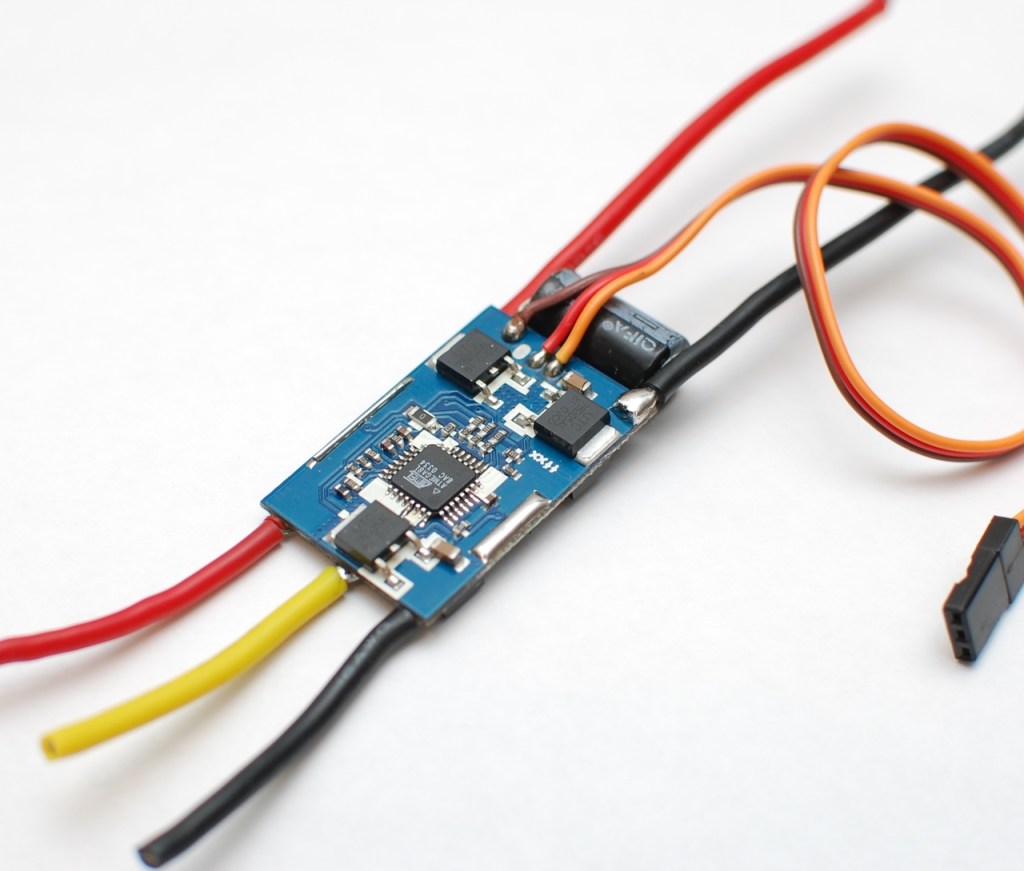
This photo shows a BEC that’s included on an ESC. The BEC is the three attached wires coming out of the right-hand side (brown, red, yellow). Typically the brown wire connects to the accessory’s negative terminal, the red wire connects to the accessory’s positive terminal, and the yellow wire is for data.
In addition to having positive and negative connection points, BECs will often have a data exchange pin or port. You can use this to send and receive data between any other components your BEC interfaces with.
For example, say a BEC is connected to an ESC. I can power a a 5-volt gyro sensor with my BEC, and send command signals for motor speed from my gyro to my ESC with the data port. On the other hand, if the BEC branches off from a flight computer then you have even more options for where to send data from accessories you plug into your BEC.
Types of Voltage Conversions
So how do BECs take the voltage from say, a 4S battery (14.8 volts), and convert it to a different voltage, like 5 volts?
There are several different ways of doing this, each with their own advantages and drawbacks.
Linear Conversions – The BEC in the picture above is advertised as being “linear mode”. This refers to how it converts the input voltage from the drone’s main battery into its offered output voltage of 5 volts. It does this with a linear power converter.
If you took apart this BEC you’d find something that looks like a simple metal fork with three prongs. A higher voltage goes in, and a lower voltage comes out at a fixed value. The excess energy lost in this conversion process is dissipated as heat. This excess heat can become a limiting factor (fire hazard), especially as amperage increases. Heat sinks are heavy.
Linear voltage conversion is very simple and doesn’t involve much circuitry. BECs with these therefore have less components that can break, and they don’t weigh much. And this simplistic circuitry comes with an additional advantage of not generating much electrical noise, which can be noteworthy when you’re working with devices that are controlled wirelessly.
The disadvantage of linear converters is that they aren’t the most efficient at using power, with somewhere around a 65% efficiency rate. But then again, if you’re powering something that relatively doesn’t use much power, as BECs typically do, then lower efficiency isn’t such a big deal.
Non-Linear Voltage Converters
This is the other class of voltage converters you’ll find in BECs. They aren’t typically advertised as “non-linear converters” but rather something more specific like:
- Buck Converter or Step-Down Converter: This takes higher input voltages and outputs a lower voltage at a steady level. If you see a non-linear BEC it’s probably this type.
- Boost Converter or Step-Up Converter: This takes a lower input voltage and outputs a higher steady voltage.
- Buck-Boost Converter or Step-Down–Step-Up Converter: This allows you to input any voltage (higher or lower) and output a specific set voltage.
- Switching Regulator or Switching BEC: All these non-linear voltage converters mentioned thus far are types of switching regulators. If you see a BEC advertised as “switching” it’s most likely a buck converter/step-down converter.
Rather than simply dissipate excess conversion energy (wastefully) as heat, these non-linear voltage converters use high-frequency pulses of electricity combined with smoothing capacitors and inductors to efficiency output a set voltage that’s converted from the original.
With an efficiency of around 90% and much less heat generation (capability for handling higher amp levels), these metrics certainly rank better than linear voltage converters. However the circuitry is more complex, and the nature of pulse-capacitor-inductor circuitry creates more radio noise, which can be detrimental to RC drone operations.
You might come across the marketing term “Universal BEC”. This is playing on a BEC that’s particularly flexible: it make work with all batteries from 1S to 6S, and it make have an adjustable output voltage.
If you look under the hood, this means it probably has a Buck-Boost converter, and many models of these include the capability to self-adjust the output voltage.
 DIY Drone Guy