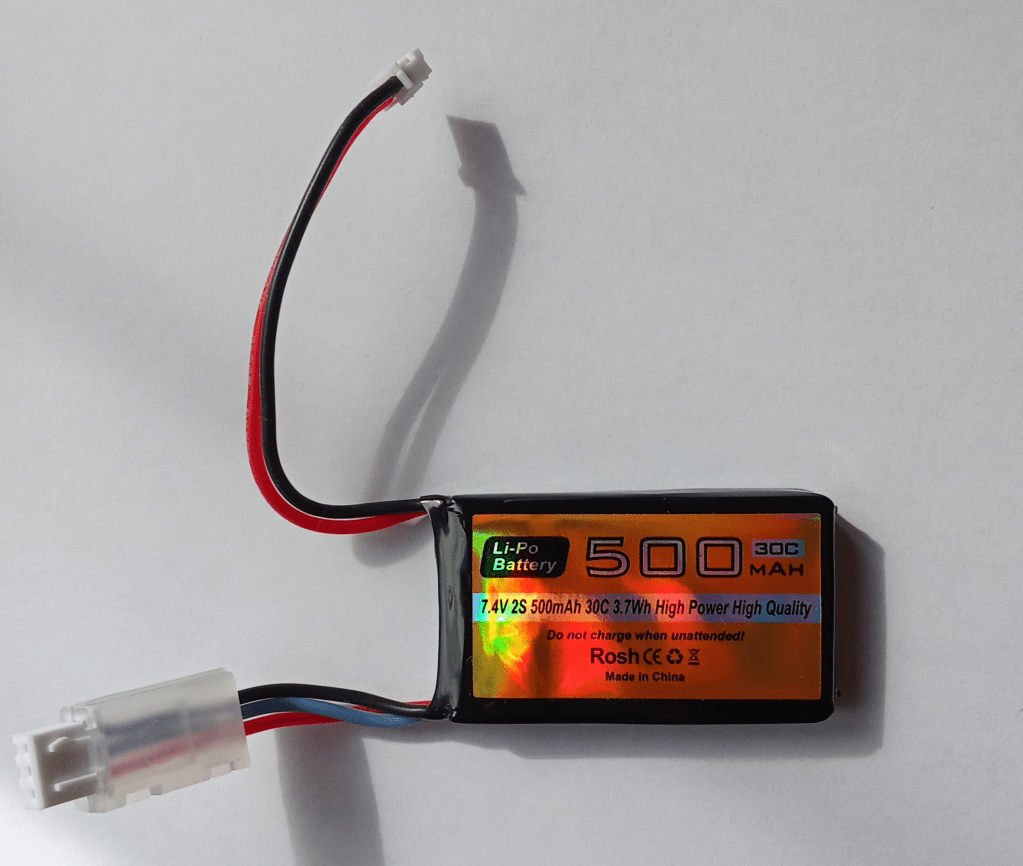
When you’re looking at drone batteries you’ll see these often referred to by their milliamp hour (mAh) rating, along with a “C” rating and an “S” rating. For example, you might see the following battery used for a basic quadcopter: 5500 mAh 5S 60C lipo.
Here’s a breakdown of what all those mean:
“S” Battery Rating
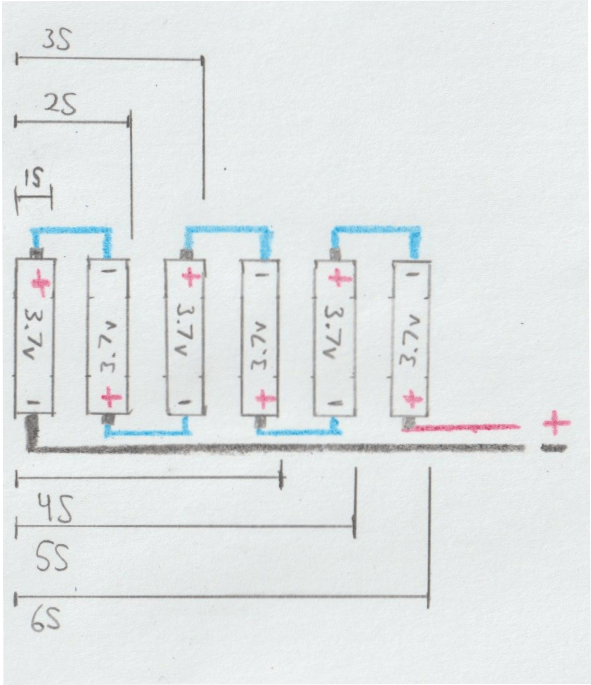
Practically speaking a battery’s “S” rating refers to its voltage. The “bigger” the drone is (including more electronics and faster-spinning motors), the more voltage it needs. Larger consumer drones will have a 6S battery, and mini drones will have a 1S battery. Here’s the voltage that corresponds to the “S” rating:
- 1S – 3.7 volts
- 2S – 7.4 volts
- 3S – 11.1 volts
- 4S – 14.8 volts
- 5S – 18.5 volts
- 6S – 22.2 volts
You’ll notice an increase of 3.7 volts between each level.
Technically, the “S” refers to how many 3.7-volt batteries are arranged in series (“S” is for “series”). A 6S battery is actually just six 3.7-volt batteries connected in series.
This has implications for charging. It’s important to make sure your battery charger is designed to accommodate the specific “S” rating of your battery.
MilliAmp Hour (mAh)
Consumer drone batteries are typically measured in milliamp hours (mAh).
Basically if your drone needs 8,000 milliamps of current to hover for one hour, it could hover with an 8,000 mAh battery for one hour. It could hover for half an hour with a 4,000 mAh battery, and it could hover for two hours with a 16,000 mAh battery. A 2,000 mAh battery would last 15 minutes.
Generally the higher the mAh rating of your battery, the more flight time you’ll have. But as the mAh rating gets higher, so does the battery’s weight. That’s why it’s important to strike the right balance between battery weight and flight time.
Realistically average consumer drones max out on flight time around 30 minutes, and many less expensive drones don’t stay airborne for more than 10 minutes before their battery needs charging.
Watt Hours (Wh)
You might see some batteries advertised with a watt hour rating, or a milliwatt hour (mWh) rating, in addition to a milliamp hour (mAh) rating. Milliamp hour ratings are really the standard; watt hour ratings are just another way of saying the milliamp hour ratings.
Remember the equation for current: I = P/V
- I is current (in this case in milliamps)
- P is power (in this case milliwatts)
- V is voltage
So for example let’s say we have a 500 mAh battery that is 2S (7.4 volts). We can fill in the current equation:
- 500 mAh = P (milliwatts) / 7.4 volts
Thus solving for P, this battery is 3,700 milliwatt hours, or 3.7 watt hours. You won’t see this formulation so often, but when you do, just remember it’s another way of saying the mAh rating.
“C” Rating
The “C” rating refers to how fast a battery can safely discharge its power; how much instantaneous power your battery can safely deliver. You’ll usually see ratings from 20C to 100C. Batteries with higher “C” ratings can offer more zing or pzaz without being damaged, regardless of their “S” rating.
If you have a racing drone and want it to blast off when you hit the accelerator then you’ll want a battery with a 100C rating. If you have a camera drone and you want to fly slow and steady from here to there, then having a high “C” rating isn’t so important.
Technically, the “C” rating refers to “capacity”. As in, rate of discharge capacity. The “C” tells you how many amps the battery can instantaneously provide safely for bursts of power. For example, a 1,000 mAh battery rated at 50C can safely provide bursts of 50 amps of current. This would be applicable to a quadcopter whose engines needed 12.5 amps of current to rev up to max power.
Here’s how the “C” number is technically calculated:
- Battery: 1,000 mAh
- 1C means the 1,000 mAh battery could be discharged over one hour at 1 amp
- 50C means the battery can be discharged at a rate that’s 50 times higher than its 1C rate: 50 amps
Check out this page if you want more specifics and detail on how to calculate the “C” value you need for your battery.
Here’s an example with a different battery:
- Battery: 5,500 mAh
- 1C means the 5,500 mAh battery can be discharged over one hour at 5.5 amps
- 60C means the battery can be discharged at a rate that’s 60 times higher than its 1C rate: 330 amps
And another example with a different battery:
- Battery: 2,000 mAh
- 1C means the 2,000 mAh battery can be discharged over one hour at 2 amps
- 60C means the battery can be discharged at a rate that’s 60 times higher than its 1C rate: 120 amps
Aside from being more expensive there’s nothing wrong with having a battery whose “C” rating is higher than you need. However if the “C” rating is lower than you need you can damage your battery. Calculating your drone’s “C” demand involves summing up its maximum amp requirements, which stem primarily from its motors but also any additional electronics.
A minimal safe rule of thumb is to get a “C” rating that’s at least 10 percent more than what you calculate you need. So if you determine your drone needs a max current of 330 amps, aim for a “C” rating that delivers at least 370 amps (round generously when working with minimal safety margins).
Lithium-Based Batteries
Most drone batteries are lithium-based. You’ll commonly see lithium-ion (Li-Ion) and lithium polymer (Lipo) advertised.
Compared with other types of batteries, lithium-based batteries have several advantages that are very suitable for drones:
- High energy density: more energy available per unit of weight
- Ability to be recharged many times
- Stable voltage, which is good for sensitive electronics like flight controllers
In Summary
By now you should be able to decipher the drone batteries you see for sale on the internet. A 5,500 mAh 5S 60C lipo has these characteristics:
- 5,500 mAh means a relatively longer flying time and increased “C” rating
- 5S means the drone requires a relatively higher amount of voltage for things like faster-rotating motors and on-board electronics
- 60C means the battery is capable of discharging 330 amps of current at any given time
- Lipo means the battery is lithium polymer-based
And remember: when you’re shopping for drone batteries, don’t forget to take weight into consideration. Some batteries might have near identical specifications, but one might weigh 20 percent more than another.
 DIY Drone Guy